
By the community, for the community: Discover the complete review by @modelisme11, a passionate maker who pushed this machine to its absolute limits.
Resin printing that changes scale
This article is written on my own initiative, without any connection to Anycubic. This is not sponsored content, and the brand had no right of review over this test. –@modelisme11
With the Photon Mono M7 Max, Anycubic is not simply looking to offer a larger M7. The machine clearly changes category. It retains the DNA of the M7 series, with a LightTurbo 3.0 light source, smart features, resin heating, and automatic feed management, but it focuses heavily on one main point: print volume.
The M7 Max is therefore less intended for those looking solely for maximum sharpness on small figurines than for users who want to print bigger, produce multiple parts at once, limit assembly, and gain comfort during long print jobs.
My opinion right from the start: it is a very attractive machine, but not a universal one. It makes a lot of sense for busts, dioramas, large figurines, props, or series of parts. On the other hand, for someone who mostly prints small, highly detailed figurines, an M7 or an M7 Pro may remain more relevant.
:format(webp)/https://fbi.cults3d.com/uploads/blog/image/image/3083/TestAnycubicPhotonMonoM7Max1-ezgif.com-rotate.jpg)
My opinion: the M7 Max is not “better” than the M7 Pro in absolute terms. It is better in a specific use case: large format. For very fine figurines, I would choose the M7 Pro instead. For busts, scenery, large parts, or production on a full build plate, the M7 Max becomes much more interesting.
3. Unboxing and first installation
3.1 An imposing machine right from unboxing
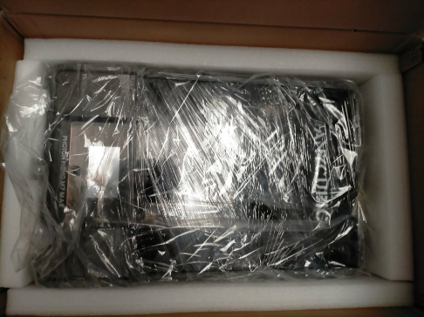
Right from unboxing, the M7 Max gives an impression of seriousness, but also of bulkiness. The package is large, the machine is heavy, and it is better to plan a real space even before starting the installation.
In my opinion, this is a printer that needs to be installed directly in its final location. Moving it regularly would quickly become a hassle. The weight of 24 kg is not excessive for a large-format machine, but it still requires careful handling.
:format(webp)/https://fbi.cults3d.com/uploads/blog/image/image/3084/Test_Anycubic_Photon_Mono_M7_Max_2.jpg)
:format(webp)/https://fbi.cults3d.com/uploads/blog/image/image/3085/Test_Anycubic_Photon_Mono_M7_Max_3.jpg)
:format(webp)/https://fbi.cults3d.com/uploads/blog/image/image/3086/Test_Anycubic_Photon_Mono_M7_Max_4.jpg)
:format(webp)/https://fbi.cults3d.com/uploads/blog/image/image/3087/Test_Anycubic_Photon_Mono_M7_Max_5.jpg) here.
here.
On the other hand, let’s be honest: for very small figurines with extremely fine details, the M7 Pro remains more suitable. The M7 Max is capable of producing beautiful detailed parts, but it is primarily thought out for large format.
:format(webp)/https://fbi.cults3d.com/uploads/blog/image/image/3088/Test_Anycubic_Photon_Mono_M7_Max_6.jpg) here.
here.
My opinion: the resolution is consistent with the format. On a large part, the details are legible, the volumes are clean, and the machine allows for obtaining a very convincing result. On the other hand, if the main objective is to print ultra-detailed miniatures, the M7 Pro is more logical.
4.3 Speed: fast for its format, but not the fastest in the range
The M7 Max can reach 86 mm/h with high-speed resin at 0.1 mm. In standard resin, it drops to 63 mm/h at 0.1 mm and 31 mm/h at 0.05 mm.
In use, the machine does not give the impression of being slow, especially if you keep its print volume in mind. However, it must be understood that speed heavily depends on the resin, the layer height, and the type of part being printed.
Where the M7 Max becomes interesting is not necessarily on the time of a single layer, but on the quantity of parts printed in a single session. A well-filled build plate allows for concrete time savings.
My opinion: I would not present the M7 Max as a racing machine. I would rather present it as a productive machine. It is not faster layer-by-layer than an M7 or an M7 Pro, but it can produce much more on a single build plate.
4.4 LightTurbo 3.0: an important element on a large build plate
The LightTurbo 3.0 light source combines a COB source, a Fresnel lens, and a light uniformity algorithm.
On a large-format printer, this is essential. The larger the exposure surface, the greater the risk of irregularity between the center and the edges can become. Good light homogeneity allows for obtaining regular exposure across the entire surface, without having to overexpose the center simply to get a correct result on the edges of the plate.
In my prints, I didn’t have this impression of having to exaggerate parameters to compensate and obtain a homogeneous result. Parts placed on different areas of the plate came out regularly, which is reassuring on a machine of this size.
:format(webp)/https://fbi.cults3d.com/uploads/blog/image/image/3089/Test_Anycubic_Photon_Mono_M7_Max_7.jpg)
:format(webp)/https://fbi.cults3d.com/uploads/blog/image/image/3090/Test_Anycubic_Photon_Mono_M7_Max_8.jpg)
:format(webp)/https://fbi.cults3d.com/uploads/blog/image/image/3091/Test_Anycubic_Photon_Mono_M7_Max_9.jpg)
Final score
8.5 / 10
The Photon Mono M7 Max is an excellent large-format resin printer, very relevant for big projects and production. It loses a few points due to its bulkiness, its less fine resolution compared to the M7/M7 Pro, and the lack of a replacement film in the box. But for its main use case—printing big, comfortably, and efficiently—it is very convincing.
Want to see more? Explore all 3D models from @modelisme11 by clicking here. Have a question about a print, a machine, or a design? You can also send them a message in one click to discuss your projects.
Recent Comments